Friday, 31 July 2015

Wonderful JS Bach in Wonderful Köthen

The distant twin spired St Jakob, viewed from the central pedestrian area.
 
Life has become a little busy for me of late, as I am now well into "Saying goodbye to friends parties,"  and feeling rather sad at the thought of leaving Timmerlah and Braunschweig on Wednesday August 12th, to fly back to the UK.

However I will be bringing back some wonderful memories with me this year, after my visits to four places I had never previously visited.  Two stand out in particular, my visit to Lüneburg with my Hamburg friends, and the other to Köthen, one of the quietest towns I have ever visited.   The purpose of most of my visits is determined by whether JS Bach had lived or worked in that particular town, and my visit to Köthen was about as good as it gets. 

St Jakob in the Market Place.

The historic centre of the town is a pedestrian area, and even though we visited on a market day, the place was deserted.   We spoke to a young father with his child, who sat next to us on a park bench.  He was born in Bavaria, but had moved to Köthen with his family in order to seek a quiet life for his children.  I presume that most people who live in Köthen work in nearby Halle or Leipzig. 
 
The Town Hall in the Market Place.

St Jakob viewed from the JS Bach memorial.

St Agnus Church, where Bach and his family worshipped.

Bach purchased a family pew in this church, and he and his family were regular worshippers here in the early 18th century.  Bach´s first wife died in Köthen, and is buried in the churchyard.

Schloss Köthen, where Bach was the Hofkapellmeister from 1717 til 1723

A facsimile of Bach´s handwritten score, and a period violin.

Schloss Köthen, in which Bach worked as the Hofkapellmeister.

Tuesday, 28 July 2015

Off to Köthen on Wednesday on my "JS Bach" Trail

A bust of the man in my life, Johann Sebastian Bach, in the Nikolaikirche in Leipzig.
 
On Wednesday morning I am off on my travels again, this time to Köthen, in Saxon-Anhalt, a town where Bach lived and worked from 1717 to 1723.    It was in this small town that he composed his famous six Brandenburg Concertos. I am very familiar with all six, and once heared them all performed one evening in the Assembly Rooms in Bath, sitting underneath one of the magnificent chandeliers.
 
Back soon with photos and for Information about my visit.

Saturday, 25 July 2015

Tracing the Bührig Ancestors in Timmerlah

 Bernd, the Timmerlah history man centre, with Mark, Gregg and Beno from the USA and Equador.
 
I was contacted some years back by a gentleman from Oregon who was researching his family´s ancestors in Timmerlah.  The title of my blog lead him to me, and I did some research, checking the local and city registers of births, marriages and deaths.
We corresponded over the years, and in 2012 Mark´s sons stayed with me while they continued the search for clues about how the Buehrig (American spelling) family came to be living in the USA.

 Sitting around the table in the former Bührig home in Timmerlah, and studying the Bührig family tree, all carefully researched by Bernd and Uwe, sitting centre.

The lady sitting to the right in the photograph is related to Mark and Gregg through her Bührig grandmother, who was in turn,  related the the Bührig Family member who travelled with his wife and child to the USA in 1890.


The WW1 war memorial in Timmerlah churchyard.

The memorial commemorates the Timmerlah soldiers who died in WW1, one of which was Hermann Bührig, a distant relative of Mark and Gregg, and the lady in the above photograph.

Wednesday, 22 July 2015

A Midsummer Evening's Opera in the Burgplatz.

 The programme for A Masked Ball, by Guiseppe Verdi.

My dear friends M and R bought me a ticket for the opera,(I bought the sweets) and we had a wonderful evening in the openair arena in the Burgplatz in front of the cathedral.  I read the story of the opera the day before, so did have some idea of what was happening!   I think I missed much, but the singing was wonderful, and made the whole experience a pleasure.


 A warm evening in the Burgplatz, with Schloss Dankwarderode, Henry the Lion's Palace in the background.

The Wiki link below will give you the story, plus tell you of the problems Verdi had with the censors during the writing of this work.

Un ballo in maschera - Wikipedia, the free encyclopedia

en.wikipedia.org/wiki/Un_ballo_in_maschera
Un ballo in maschera (A Masked Ball) is an opera in three acts by Giuseppe Verdi with text by Antonio Somma. However, Somma's libretto was itself based on the five ...
 
 
 Floodlights against the background on the Palace and the tower of the Rathaus.


Henry's Lion on its plinth stands hidden for the duration of the opera.


The stage and a part of the audience.


A sneaky photo of the action taken by my friend ???????

Sunday, 19 July 2015

With JS Bach again in St Andreas Church.

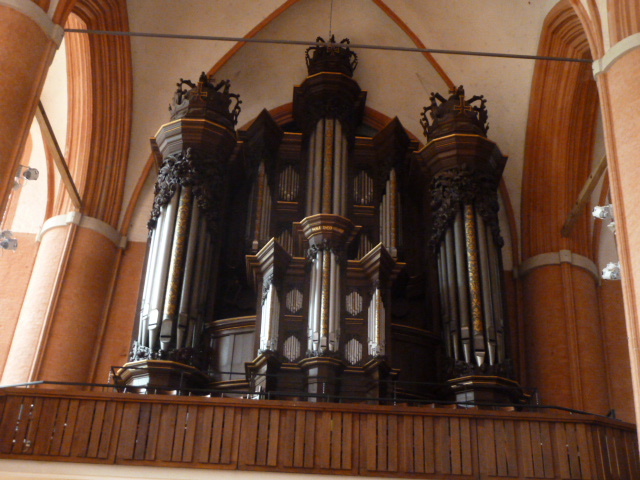
The organ in St Andreas.  
 
During July I been going to a series of organ recitals given in the church at 5pm on every Friday,  where the organist, Rüdiger Wilhelm,  plays several short works, and always includes a work by JS Bach.
 
Last Friday was no exception, when he played Bach´s "Fugue in G Major, BWV 376," a work with which I am familiar.   Bach never visited Braunschweig, (unless he did, and his visit was not recorded) so it is good to hear music that pays homage to one of Germany´s greatest composers.   He also performed "Prelude in D Minor" by Dietrich Buxtehude, a Danish/German composer who much influence Bach´s compositions.  As a young man, Bach walked from Lüneburg to Hamburg and Lübeck, in order to hear Buxtehude play.

The church is hosting an art exhibiton about homelessness, with exhibits by those who once lived on the streets throughout the world. 
 
We observe the faces of those less fortunate than ourselves, and most of us just turn away!
 
 
The tower of St Andreas standing behind the Alte Waage, a recently restored old warehouse, which had been destroyed in WW2.

Thursday, 16 July 2015

Lüneburg, the Best Yet, (but I say that about all the places I visit.)

 The old Harbour.
 
I met my Hamburg friends at the railway station, and the first thing we decided to do was to find a nice café and have a beer!  A very sensible idea, considering how warm the day was.  M and J have visited Lüneburg before, so we walked directly to the old Harbour area, and sat under a sunshade, roughly in the middle of the above photo. 
 
Lüneburg, which was hardly damaged in WW2  is one of many cities on the "European Gothic Brick Trail."  In the absence of stone for building houses, clay bricks were the only Option apart from timber.   Anyone with a real interest in bricks of all colours should visit this wonderful city.


The old crane in the harbour area.

Lüneburg´s wealth was built on salt, (it stands on a salt dome) and there is a Salt Museum in the city, but with limited time we did not manage to visit.  Salt was shipped from here on the River Ilmanau, to others towns, and used for the preservation of  fish.

Houses near the Michaelis church.

It was good to walk the narrow streets of the old town, where my dear friend JS Bach must have walked as a teenager.   He attended the school in the cloisters of the Michaelis Church from 1700 to 1703, aged 15 years old.

The link below will give you more Information about the City, although you may have to cut and past the Website address to your seach box.  The links used to work automatically, but some don´t seem to anymore.

Lüneburg - Wikipedia, the free encyclopedia

en.wikipedia.org/wiki/Lüneburg
Lüneburg, also called Lunenburg in English, is a town in the German state of Lower Saxony. It is located about 45 km (28 mi) southeast of another Hanseatic city ...

Gothic brick houses, for which the city is famous.

The detail of the brickwork was most interesting, with alternating colours and various textures.

The Rathaus

Michaelis Church, where JS Bach sang and was educated from 1700 til 1703

Bach sang in the choir of this brick built church, but when his voice broke, he received his first tuition on the organ here.


The organ built in 1705, after Bach's time, in the organ loft.

The 17th century marble pulpit.
 
 
The city stands on the edge of Lüneburg Heath, and area of extensive heathland, typical of those that once covered most of the North German countryside until about 1800, but which have almost completely disappeared in other areas.
 
The heaths were formed after the Neolithic period by the overgrazing of the once widespread forests on the poor sandy soils of the geest, as this slightly hilly and sandy terrain in northern Europe is called, making Lüneburg Heath a historic cultural landscape. 
 
  The remaining areas of heath are kept clear mainly through grazing, especially by a North German breed of moorland sheep called the Heidschnucke.  The Heath´s  unique landscape make it a popular tourist destination in Northern Germany.


Sunday, 12 July 2015

A Great Day out with Waggum Choir in Magdeburg.


Monika on the microphone checking that everyone has arrived before the coach left.
 
Waggum Lady's Choir consists of about 50 singers, sopranos and altos of all ages, who sing folk and gospel songs in both English and German.  I met two of the members in an English group, and they asked me if I would like to sing with them, and I said "Yes, of course, I would love to."
 
Monika above, is the choir's secretary, and arranged a really lovely visit for us all to Magdeburg, on the River Elbe in Saxony-Anhalt,   We travelled in a lovely German coach with all mod cons, and the journey from Waggum to the city took just over an hour. 

The group on arrival in Magdeburg, with the splendid German coach in the background.

We were lucky to have a really good city guide, who accompanied us on the ride around the city in the coach, and then back to the Cathedral quarter for a walk around the area.  He spoke much too quickly for me to understand all that he said, but he was amusing, and I could understand many of his jokes.

The city guide explaining the lay out of the old medieval town on a bronze model of the city.
 
 Lunch in the café in the Rathaus.
 
From the Cathedral quarter we rejoined the coach for a short ride to the Old Market Place.   Here we went into the Rathaus café for lunch and a beer.  The food was excellent, although it took rather a long time to arrive!
 
On board the boat for a view of the city from the River Elbe.
 
After lunch we drove down to the river for a trip on a boat to see the sights from water level.  Once again all the commentary was in German, and when I concentrate I can understand most of what is said, although I sometimes lose the will to live, and have to switch off for a while.  Speaking and listening to a foreign language is hard going after a while.
 
This is the time when I have to seek out another English speaker, and I was fortunate enough to meet a lady, whose son is married to an Indonesian lady, and who has to speak to her daughter in law in English.  Oh bliss, I was able to chat away with her without having to think too much.   Sometimes my head buzzes with toooo much German!
 
The link below will give you more information about the city.

Magdeburg - Wikipedia

en.wikipedia.org/wiki/Magdeburg
Magdeburg is the capital city of the state of Saxony-Anhalt, Germany. Magdeburg is situated on the Elbe River and was one of the most important medieval cities of Europe.

Up on the viewing tower looking over the locks that connect the Mittelland Canal with the Elbe-Havel Canal.
 
The viewing tower was several floors up, with many steps, and I was a little puffed out when I got to the top.   Coming down was a doddle!

The link below will give all the information about the connection of these two waterways. 

Magdeburg Water Bridge - Wikipedia

en.wikipedia.org/wiki/Magdeburg_Water_Bridge
The Magdeburg Water Bridge is a large navigable aqueduct in central Germany, located near Magdeburg. The largest canal underbridge in Europe, it spans the river Elbe ...

Great German cakes await us at the Mühlencafe at Morsleben Mill.
 
After a short drive from the canal junction, we enjoyed tea and cake in a very interesting old mill, that had been converted into a café and a small museum.  It was possible to look around the old buildings, with a large display of old machinery and utensils involved in the milling process.
 
Singing folk songs at the Mill cafe.

After our enjoyable tea and a big piece of cake, and a tour around the mill and museum, we gathered in the shade and sang some folk songs for those still customers enjoying the snacks.  It was a lovely day out, one of the very best I have ever spent in Germany.   I think it was because I was with a group of singers, and singers around the world are always good company.    
 
My motto is:  "Join a choir, sing your socks off,  and have a really good time."